Pages

Thursday, December 20, 2007

Another Kind of Clash of Civilization I.


It was in Thailand. I was working in a factory. One day, our manager sent me to a market where was located about three blocks away from our factory, to buy something. He also gave me his motorcycle to ride to the market. At that time, I did not know how to drive a motorbike. When I said that I did not know how to drive a bike, a little boy, who could be around five years old, told with astonishment that ‘You are human. You don’t know how to ride a motorbike?” I felt ashamed a little of it.
The boy was right. He was born in Thailand, one of the richest countries in South East Asia where almost every adult has a motorbike or a car. Since he was born, he sees that every human being is driving a motorbike or a car in daily life. So, he probably interpret in his knowledge through his experience that knowing how to drive bikes and cars is one of the natural skills of human beings. I came from very remote area of Burma, one of the poorest countries in the world where to own a bicycle is a golden dream for most of children.
In our Arakan, many people have never seen a train because we don't have even one inch of railroad track. Every Burmese government through out history just tries to occupy everything, from natural resources to historical heritages of Arakan, but they never think for the benefit of Arakanese and give anything back to the real owners of the land.

I learned how to ride a bicycle when I was a high school student but yet I did not have a bike. I knew how to ride a motorcycle three years later after I got in Thailand.

During the fall semester of 2006, I took sociology class and our class formulated a survey that was conducted at the College of DuPage. According to the survey, eighty-five percent of students use personal vehicle, which means almost every adult has a car in the United States. I began to learn how to drive a car in 2005 in the United States.

In Longman American English dictionary, the definition for the word, ‘car’ is – ‘a vehicle with four wheels and an engine, used by a small number of people for traveling from one place to another.’ However, when the people from poor countries interpret the word, ‘car,’ - it means ‘luxurious’ ‘rich’ ‘high standard’ ‘elite’ and so on, while people from rich countries interpret ‘car’ as a shoe, which is just something useful tool in daily life.

If I came here when I was a high school student before I did not know how to ride a bicycle, I could not imagine that how and what question that a five year old American boy could ask me.


Picture: http://www.bridalwave.tv/flower-expert-red-and-pink-roses.jpg

Wednesday, December 19, 2007

Four Essentials for Happiness


You may have a thousand different goals over the course of your lifetime, but they all will fall into one of four basic categories. Everything you do is an attempt to enhance the quality of your life in one or more of these areas.
The Key to Happiness
The first category is your desire for happy relationships. You want to love and be loved by others. You want to have a happy, harmonious home life. You want to get along well with the people around you, and you want to earn the respect of the people you respect. Your involvement in social and community affairs results from your desire to have happy interactions with others and to make a contribution to the society you live in.
Enjoy Your Work
The second category is your desire for interesting and challenging work. You want to make a good living, of course, but more than that, you want to really enjoy your occupation or profession. The very best times of your life are when you are completely absorbed in your work.
Become Financially Independent
The third category is your desire for financial independence. You want to be free from worries about money. You want to have enough money in the bank so that you can make decisions without counting your pennies. You want to achieve a certain financial state so that you can retire in comfort and never have to be concerned about whether or not you have enough money to support your lifestyle. Financial independence frees you from poverty and a need to depend upon others for your livelihood. If you save and invest regularly throughout your working life, you will eventually reach the point where you will never have to work again.

Enjoy Excellent Health
The fourth and final category is your desire for good health, to be free of pain and illness and to have a continuous flow of energy and feelings of well-being. In fact, your health is so central to your life that you take it for granted until something happens to disrupt it.

Action Exercises
Here are three things you can do immediately to put these ideas into action.
First, take time on a regular basis to think about what would make you really happy in each of the four areas.
Second, set specific, measurable goals for improvement in your relationships, your health, your work and your finances and write them down.
Third, resolve to do something every day to increase the quality of some area of your life - and then keep your resolution.


Source: Brian Tracy’s Newsletter
Picture: http://docwhisperer.files.wordpress.com/2007/08/happiness.jpg

Saturday, December 15, 2007

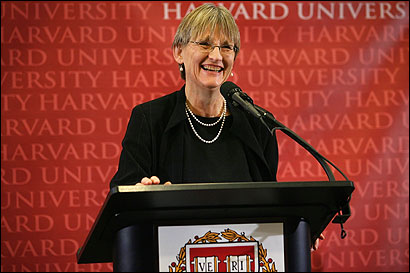
Quote of the Week (Education is Power) and Top Ten Universities in the World


“Education is the engine that makes American democracy work. And it has to work, and that means people have to have access.”

Drew Gilpin Faust
President of Harvard University


Top Ten Universities in the world are as below and since the list has two institutions, which are ranking in the same number 4, I take number 11 into the top ten:

1
Harvard University (United States)
2
University of Cambridge (United Kingdom)
3
University of Oxford (United Kingdom)
4=
Massachusetts Institute of Technology (MIT) (United States)
4=
Yale University (United States)
6
Stanford University (United States)
7
California Institute of Technology (United States)
8
University of California, Berkeley (United States)
9
Imperial College London (United Kingdom)
10
Princeton University (United States)
11
University of Chicago (United States)


Source:
Time / December 24, 2007
http://www.topuniversities.com/worlduniversityrankings/results/2006/
Photo:
http://graphics.boston.com/bonzai-fba/Globe_Photo/2007/02/12/1171277138_0554.jpg

Thursday, December 13, 2007

New Europe: The Beauty of Unity in Diversity


In Eighteenth, Nineteenth and early Twentieth centuries, it was the Europe’s world. We could see the powers in any corner of any region of the world were Europeans. Great Britain, France, Spain, Portugal and Netherland were leading powers, especially the U.K.

In the century of twentieth, world’s leading stage moved to the United States; in all arenas of - economically, politically, educationally and in the field of military as well.
During the first decade of the 21st century, new powers have occurred in the world’s stage, such as China and India.

Now, the European countries are searching for the place of Europe in the new world, which has been changing very rapidly. The 27 member countries of the European Union signed a new treaty, which is called ‘Lisbon Treaty,’ today.

With almost 500 million citizens the EU generates an estimated 31% share of the world's nominal GDP (US$15.8 trillion) in 2007. It represents its members in the WTO and observes at G8 summits and at the UN. Twenty-one EU countries are members of NATO.

There are many pros and cons on this new treaty. The bottom line is that we can see ‘the beauty of unity among the diversities’ in the European Union.

Welcome the New Europe in the New World!


If you want to read new Treaty Text of EU, click this link;
http://news.bbc.co.uk/2/shared/bsp/hi/pdfs/11_12_07treatya.pdf

Protocols and declarations;
http://news.bbc.co.uk/2/shared/bsp/hi/pdfs/11_12_07treaty.pdf

Source:
http://www.bbc.co.uk/
http://europa.eu/
http://en.wikipedia.org/wiki/
Picture: http://www.delegy.ec.europa.eu/images/Eu_Img.jpg

Mathematics in Daily Lives and 4 Steps to solve application Problems


In this semester, I am taking ‘Business Math.’ People often ask me that what classes I am taking in this semester. When I answered ‘Business Math’ is one of my classes, some people acted like they are afraid of the subject ‘math.’ I did, too.
Actually, mathematics is part of our daily lives. Look at the following sentences, which we usually speak in our daily lives;
‘What time did you wake up this morning?’
‘Do you eat three meals per day?’
‘Mortgage rate is much higher now.’
‘Oh…it is minus 2 degrees today; such a cold day!’
‘I ate three apples already today.’
‘How many letters do you have to reply today?’
‘My inbox has 80 mails and 3 junk mails.’
‘This is December 12; I have an appointment at 2 pm.’
‘It is 4:00; I have to go now.’

Do you see in which role mathematic plays in our daily lives? It is part of our lives.
Any way, our text book in our business math is ‘Mathematics for Business’ by Salzman, Miller and Clendenen.
There are many interesting notes in this book and I would like to share with you here about four steps for solving application problems. Sometimes, it could not be wrong to use mathematical ways to solve the problems of our daily lives.

Here are the four steps to solve application problems;
Step 1. Read the problem carefully, and be certain that you understand what the problem is asking. It may be necessary to read the problem several times.
Step 2. Before doing any calculations, work out a plan and try to visualize the problem. Know which facts are given and which must be found. Use indicator words to help determine your plan.
Step 3. Estimate a reasonable answer using rounding.
Step 4. Solve the problem by using the facts given and your plan. Does the answer make sense? If the answer is reasonable, check your work. If the answer is not reasonable, begin again by rereading the problem.
Note: Be careful not to make the mistake that some students do – they begin to solve a problem before they understand what the problem is asking. Be certain that you know what the problem is asking before you try to solve it.

Finally, I would like to share the words that a comedian who graduated in math, once said in an interview, with you. How he took the math into his life perspective do you know? He said about one of the rules in math that ‘Without the Same Base, the Powers CANNOT plus or minus.’
Is that right?


Photo: http://www.rjcooper.com/talk-n-scan-calculator/talk-n-scan-calculator.jpg

Tuesday, December 11, 2007

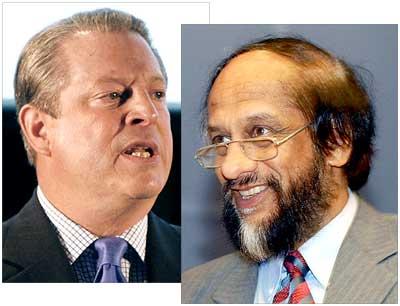
Voices from Nobel Week


By awarding the Nobel Peace Prize for 2007 to the IPCC and Al Gore, the Norwegian Nobel Committee is seeking to contribute to a sharper focus on the processes and decisions that appear to be necessary to protect the world’s future climate, and thereby to reduce the threat to the security of mankind. Action is necessary now, before climate change moves beyond man’s control.

The Norwegian Nobel Committee


Coming as I do from India, a land which gave birth to civilization in ancient times and where much of the earlier tradition and wisdom guides actions even in modern times, the philosophy of "Vasudhaiva Kutumbakam", which means the whole universe is one family, must dominate global efforts to protect the global commons.

R K Pachauri
Chairman
Intergovernmental Panel on Climate Change (IPCC)
The Nobel Peace Prize Laureate 2007
(Oslo, December 10, 2007)


We are what is wrong, and we must make it right."
In every land, the truth - once known - has the power to set us free.
Truth also has the power to unite us and bridge the distance between "me" and "we," creating the basis for common effort and shared responsibility.
There is an African proverb that says, "If you want to go quickly, go alone. If you want to go far, go together." We need to go far, quickly.

Albert Arnold (Al) Gore Jr.
Former Vice President of the United States
The Nobel Peace Prize Laureate 2007
(Oslo, December 10, 2007)

PS: The Nobel Peace Prize was awarded to Daw Aung San Suu Kyi, Burma's Democratic Leader, in 1991 for her non-violent struggle for democracy and human rights.

Source: http://nobelprize.org/
Photo:
http://profiles.nlm.nih.gov/KK/B/B/M/B/_/kkbbmb.jpg
http://im.rediff.com/news/2007/oct/12nlook1.jpg

Sunday, December 9, 2007

Wednesday, December 5, 2007

Happy Birthday Your Majesty!


“May the power of the Triple Gems and holy spirits protect you all from suffering, danger and make you happy, always."

King Bhumibol Adulyadej of Thailand


Happy Birthday Your Majesty!


Source: www.nationmultimedia.com